Capital not only draws on socio-spatial differences within the workforce to increase rates of exploitation, but also actively creates and reinforces such fissures. The contributions to this special issue show that uneven spatial configurations are decisive for our understanding of multiscalar labour fragmentation and the uneven agency of (wage) w1orkers. They indicate how Labour Geography can contribute to a better understanding of the interlinkages between class-based exploitation, glocal uneven development, divisions within the working class, and worker alliances. This special issue is an invitation to bring Labour Geography into conversations with concepts of uneven geographical development. Through this dialogue, uneven geographical development appears as precarious, unstable, and as forwarding the temporary dis-/integration of (wage) workers into the restless landscapes of capitalism. This entails their contingent and uneven construction as social actors. Labour’s (emancipatory) agency must therefore start from the given particularising-hierarchical attributions in order to transcend them.
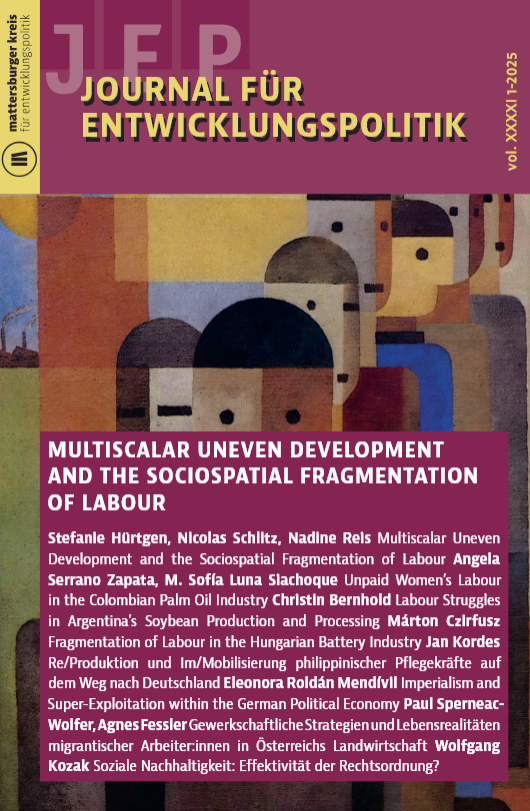
The new JEP is out: Multiscalar Uneven Development and the Socio-Spatial Fragmentation of Labour
JEP 2025-1