
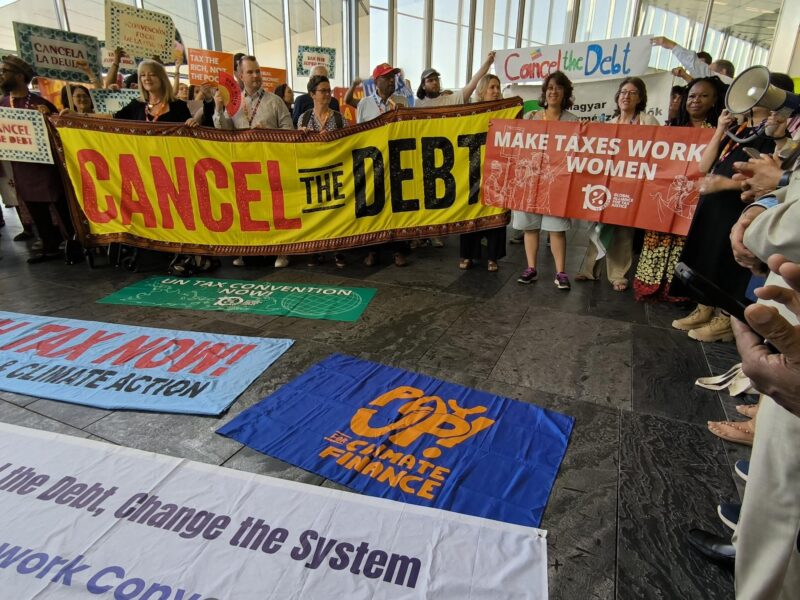
From June 30 to July 3, 2025, the 4th International Conference on Financing for Development (FfD4) took place in Seville, Spain (#FFD4). A broad debate ranged from taxes to trade, from private sector investments to debt, from public development cooperation and trade to fundamental, systemic issues. Over 300 well-attended side events, Business Forum events, daily presentations of initiatives from the Seville Platform for Action, plus the plenary and round table debates kept the more than 15,000 participants on their toes. I was able to attend as a civil society expert and member of the Austrian delegation.
It was hot not only outside, with temperatures well above 40 degrees, but also inside the conference building. On the last day of the conference, representatives of civil society demonstrated loudly not only for their demands, but also against their low visibility and participation at the conference. Amina Mohammed, UN Deputy Secretary-General, showed understanding for the NGOs’ demands, praised their ongoing commitment, and promised future remedies.
Given the current challenges and crises, NGOs would have liked to see more comprehensive and far-reaching reforms. They wanted to bring the global financial system into the UN and thus put it on a broader footing, instead of leaving it to institutions that continue to be dominated by Western countries. They wanted to break new and innovative ground in the face of a global system that has reached its limits – For People and Planet, as the CSO Forum put it.
Critical CSO-Pre-Forum
The UN conference was preceded by a CSO forum, a two-day pre-conference of civil society organizations. In view of the many current crises (wars, trade conflicts, climate crisis, rising inequality), NGOs and grassroots groups around the world had hoped for a strong statement from the states. Many countries, especially the poorest ones, are heavily indebted and spend up to 20% of their government revenues solely on debt repayment. International development cooperation and humanitarian aid are declining rapidly, and this is not only due to the withdrawal of the US. International trade, another source of income for countries in the Global South, has been severely disrupted by US tariff policies.
Many interventions by feminist, human rights, and environmental organizations from around the world clearly showed how a financial system can have a negative impact on many people, especially marginalized groups. Peace organizations also criticized the fact that the financial implications of increasing armed conflict and massive arms buildup were hardly addressed in the FFD process.
The FFD4 final document, the Compromiso de Sevilla, does not meet the requirements of the times, was the unanimous opinion of more than 1,000 representatives of civil society. They were particularly disappointed that the first development finance conference on European soil was not used by Europe to initiate far-reaching reforms of the international financial system. The forum recorded its criticism and disappointment in a detailed final document, which was forwarded to the UN at the beginning of the conference.
Instead of democratising the international financial system and transferring more powers in this area to the UN as the only global institution, Europe primarily sought to maintain the status quo in international institutions where countries of the Global South are underrepresented or not represented at all.
Strong support for the CSOs came from Amina Mohamed, Deputy Secretary-General of the UN, who attended the CSO Forum alongside the Spanish Minister for Development and the Spanish Vice President. She emphasized the important, critical role of civil society as well as the contents of the NGO final document, the Global People’s Assembly Declaration. Despite the strong efforts of the host country Spain, the Compromiso remained a somewhat lukewarm compromise, which was also due to the current difficult circumstances.
One positive exception: the negotiations on a UN tax framework agreement, the next round of which will begin in early August. NGOs and governments from the Global South had similar agreements in mind in the areas of debt and international development cooperation. Neither was possible and both failed due to resistance from rich countries. Instead, many initiatives were presented in Seville that have yet to prove their success.
FFD4 had to contend with an extremely difficult environment. Advocating for multilateralism and showing support was certainly an important sign. But it should not be hollow multilateralism. After all, the aim was to plug the huge financial gap of over 4 trillion euros per year (!), without which the fulfillment of international sustainability goals remains an empty promise.
Perhaps we simply need to quote John Lennon once again: “Everything will be fine in the end. And if it’s not fine, then it’s not the end.” We in civil society should not lose our confidence. After all, who among us who demonstrated for a “UN Tax Body” at #FFD3 in Addis Ababa in 2015 and were ridiculed by many would have thought that we might already have a fully negotiated UN tax convention in 2027?
Martina Neuwirth is the Chairperson of the Mattersburger Kreis. She works also as Senior Expert at VIDC in the field of International Tax Policy and Development Financing.
> Official UN website for the conference
> CSO-Forum ahead of the Development Finance Conference